Commercial painting cost is often expressed as a price per square foot, but that number can be misleading without a clearly defined scope. The size of the commercial building matters, yet so do its paintable surface area, condition, height, operating schedule, coating requirements, and accessibility.
Published pricing guides also provide substantially different figures. Some place commercial painting between $1 and $4 per square foot, while another cites $2 to $6 per square foot. These are broad planning benchmarks, not fixed prices from Brotherton Painting or guaranteed rates for Seattle properties.
In this guide, we explain how square-foot pricing works, why the average cost can vary, which other factors increase the overall cost, and how property owners can compare commercial painting estimates on equal terms.
How Much Does Commercial Painting Cost per Square Foot?
Published commercial painting cost per square foot estimates vary considerably by project type and scope, with the sources used for this guide placing general commercial rates between $1 and $6 per square foot.
A separate source places exterior painting between $0.70 and $3.50 per square foot. However, these figures should be treated cautiously because the included labor, materials, prep work, coats, repairs, and equipment may differ.
The going rate does not provide a useful comparison unless every painting contractor measures the same surface area and includes the same work. An accurate estimate should clarify:
- Which surfaces are included
- Whether the price covers one coat or two coats
- What surface preparation is required
- Whether surface repair is included
- Which paint and coating system will be used
- Whether lifts or other specialized equipment are necessary
- Whether the work must occur outside regular business hours
These details explain why two bids for the same commercial building can have very different totals. Each contractor may use its own set of measurement and scope assumptions, so the underlying inclusions matter as much as the headline rate.
Floor Square Footage vs. Paintable Surface Area
A building’s floor area is not the same as its paintable surface area. Floor square footage measures the usable space within the property. Paintable square footage measures the walls, ceilings, exterior elevations, trim, doors, and other surfaces included in the paint job.
A commercial space can therefore contain significantly more paintable square feet than its listed floor area. High ceilings, multiple interior partitions, long corridors, exposed structural elements, and detailed wall layouts all increase the surface area without increasing the building’s footprint.
Before comparing a cost per square foot, ask whether the contractor calculated the rate using:
- Total floor square footage
- Wall and ceiling square footage
- Exterior elevation area
- The complete paintable surface area
The estimate should also identify surfaces that are excluded. Without the same measurement method, the price per square foot from one bid cannot be compared directly with another.
How the Commercial Building and Paint Job Scope Affect Cost
Commercial painting projects differ from residential work in scale, materials, access, scheduling, and coordination requirements. Property owners can review the differences between residential and commercial painting before using residential painting prices to forecast a commercial project cost.
A commercial estimate should define the surfaces being painted, required preparation and repairs, number of coats, materials, access requirements, and work schedule. These factors make the scope more useful for budgeting than building size alone.
Interior Commercial Painting Cost Factors
Interior commercial painting cost depends heavily on how the space is used and whether it remains occupied during the work. An empty interior is generally easier to access than an active office, store, medical space, or other operating facility.
Occupied buildings can require additional planning to protect furniture, equipment, inventory, floors, and active work areas. Crews may need to divide the interior into phases rather than painting the entire space at once. More masking tape, coverings, supplies, movement, and cleanup can increase labor costs.
Wall and drywall condition also matters. Minor preparation is different from extensive drywall repair, damaged surfaces, staining, peeling coatings, or moisture-related deterioration. High ceilings and hard-to-reach areas can require specialty equipment, such as scaffolding or lifts.
The estimate should distinguish routine prep work from repair work so the property owner can see what is included in the total cost.
Exterior Commercial Painting Cost Factors
Exterior work brings a different set of variables. Building height, access, surface type, exposure, and existing coating condition can affect both the labor and equipment needed for the job.
Preparation may include cleaning, power washing, scraping, sanding, priming, or surface repair. If damaged surfaces are discovered, the painting contractor may need to address those areas before applying a new coat. EPA moisture-control guidance also identifies leaks, condensation, humidity, and other sources of moisture as factors that can affect building materials.
Seattle’s precipitation patterns can influence exterior painting schedules, preparation, and coating application. NOAA’s Seattle-Tacoma climate normals show frequent measurable precipitation throughout the year. Pre-1978 child-occupied facilities, including schools and child care facilities, can be subject to lead-safe requirements when renovation or painting work disturbs painted surfaces. Property owners can review Seattle guidance on lead-safe renovation when evaluating whether these requirements apply to a project.
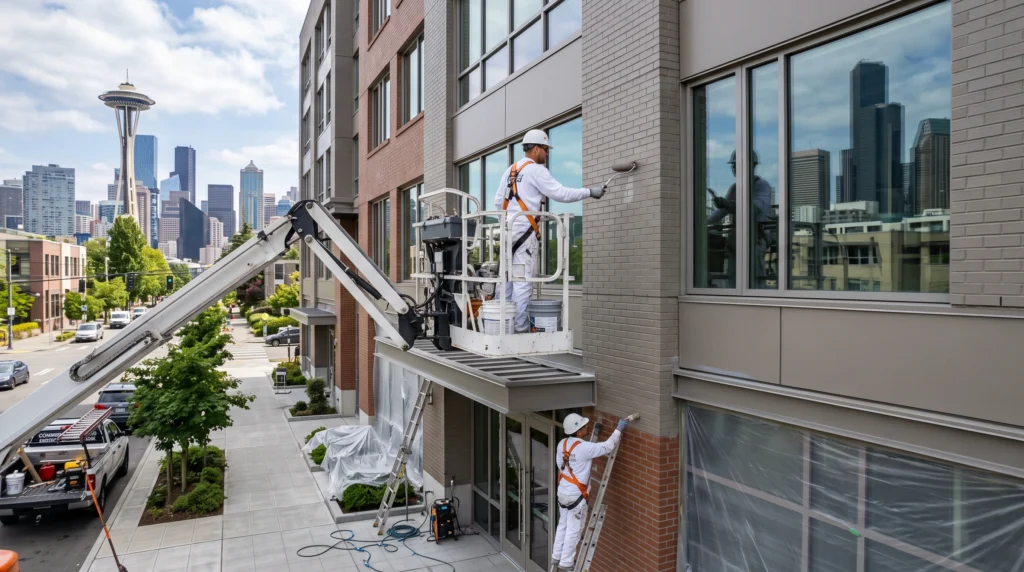
For multi-story properties, specialized equipment can become a substantial part of the project scope and cost. Lifts and scaffolding also introduce specific safety and operating requirements covered by OSHA scaffold and aerial-lift requirements. A bid should state whether this access equipment is included instead of leaving it as an undefined additional charge.
Labor Costs, Occupied Buildings, and After-Hours Scheduling
Labor is often a major part of commercial painting cost. Published pricing guides used for this article place broad labor rates between $55 and $120 per hour, but this is not a confirmed Seattle rate or a Brotherton Painting price.
The actual labor charges vary depending on surface condition, detailed work, accessibility, crew requirements, and scheduling. For example, a straightforward paint job completed during regular business hours may require fewer accommodations than work completed around customers, tenants, employees, or other contractors.
Evening, weekend, and after-hours scheduling can help a company reduce disruption, but it may also raise the project cost. The contractor may need to mobilize crews repeatedly, work in shorter phases, or coordinate job site access with a property manager or general contractor.
The bid should explain whether after-hours work is required, optional, or already included in the labor rate.
Material Costs, Number of Coats, and Specialty Paints
Paint quality, coating type, surface absorption, and the number of coats influence how much paint and primer the project requires. One supplied guide estimates that a gallon of paint covers approximately 300 square feet. Actual coverage can vary depending on the product, surface texture, application method, and existing color, so estimators should check manufacturer coverage specifications for the selected coating rather than relying on a single generic figure.
Two coats require more paint, labor, and time than one coat. Significant color changes, porous surfaces, repairs, and uneven existing finishes can also affect the coating system.
The pricing source used for this guide places quality paint between $50 and $100 per gallon and gives the same broad range for certain specialty paints, depending on the product. These material costs are general benchmarks and do not represent a Brotherton quote.
Commercial properties may also require coatings that serve a specific function:
- Epoxy coatings
- Waterproofing systems
- Anti-graffiti coatings
- Antimicrobial coatings
- Fire-resistant coatings
- High-durability finishes
These products should appear as separate line items when they materially affect the bid. Comparing a standard latex paint proposal with a specialty coating proposal based only on the total price would not be an equal comparison.
How Property Type Changes a Commercial Painting Project
Commercial properties can require very different painting scopes depending on their surfaces, access, occupancy, and operating requirements. Property owners can review commercial painting projects across Puget Sound to understand the range of commercial environments a contractor may handle. The most useful comparison is a project with similar surfaces, access conditions, materials, and operating constraints rather than simply a similar number of square feet.
What an Accurate Estimate From a Painting Contractor Should Include
An estimate from a professional painter should make the project scope easy to understand. A low total may look attractive until the owner discovers that repairs, equipment, extra coats, or after-hours work were excluded.
When requesting commercial painting services in Seattle, ask the painting company to identify:
- Total square footage and measurement method
- Paintable surfaces included in the project
- Areas and services excluded from the bid
- Surface preparation and repair requirements
- Drywall repair or other corrective work
- Paint manufacturer, product, finish, and quality level
- Primer and number of finish coats
- Labor costs or labor assumptions
- Paint, primer, other materials, and supply costs
- Equipment, lifts, and access requirements
- Occupied-building protection and phasing
- Regular, evening, weekend, or after-hours scheduling
- Cleanup and project completion requirements
- Optional items and potential additional costs
If a condition cannot be confirmed before work begins, the estimate should explain how that issue would be evaluated and priced. For small jobs, property owners should still request the same scope details rather than relying only on a general square-foot benchmark.
How to Compare Commercial Painting Bids
Start by confirming that every painting contractor is bidding on the same scope. The lowest price may cover less work, while a higher bid may include surface repair, two coats, premium materials, specialized equipment, or a schedule designed to keep the business operational.
Compare | Questions to ask |
Square footage | Is the price based on floor area or paintable surface area? |
Preparation | Are cleaning, power washing, scraping, priming, and repairs included? |
Materials | Are the paint products and specialty coatings clearly identified? |
Coats | Does the bid include one coat, two coats, or a specified coating system? |
Labor | Are after-hours work and occupied-space requirements included? |
Equipment | Are lifts, scaffolding, and other equipment part of the total cost? |
Exclusions | What could result in an additional charge? |
A useful bid comparison considers scope, materials, labor, access, schedule, and expected quality results together. Before spending money on a commercial painting project, compare these inclusions rather than relying on total cost alone, which can conceal important differences between proposals.
Commercial Painting Cost FAQ
What is the going rate for commercial painting per square foot?
The supplied industry sources cite different benchmarks, including $1 to $4 and $2 to $6 per square foot. The actual price varies depending on paintable surface area, preparation, materials, labor, building access, and scheduling.
Is commercial painting priced by floor area?
Not always. Some preliminary estimates reference floor square footage, but a detailed bid should account for the actual walls, ceilings, exterior elevations, and other surfaces included in the paint job, including whether ceiling paint is part of the scope.
Does an occupied commercial building cost more to paint?
It can. Protecting active areas, moving between phases, coordinating access, and working outside regular business hours may require more labor and supplies.
Why do two commercial painting estimates differ so much?
The contractors may be using different square-foot measurements or including different preparation, repairs, coats, materials, equipment, and scheduling requirements.
Are epoxy and anti-graffiti coatings included in a standard painting bid?
They should not be assumed. Epoxy, waterproofing, anti-graffiti, and other specialty coatings should be identified in the scope and estimate.
How can I get an accurate commercial painting estimate?
Provide contractors with the same project information and request a detailed site-specific proposal. Compare the included surfaces, prep work, materials, number of coats, labor, equipment, schedule, and exclusions.