
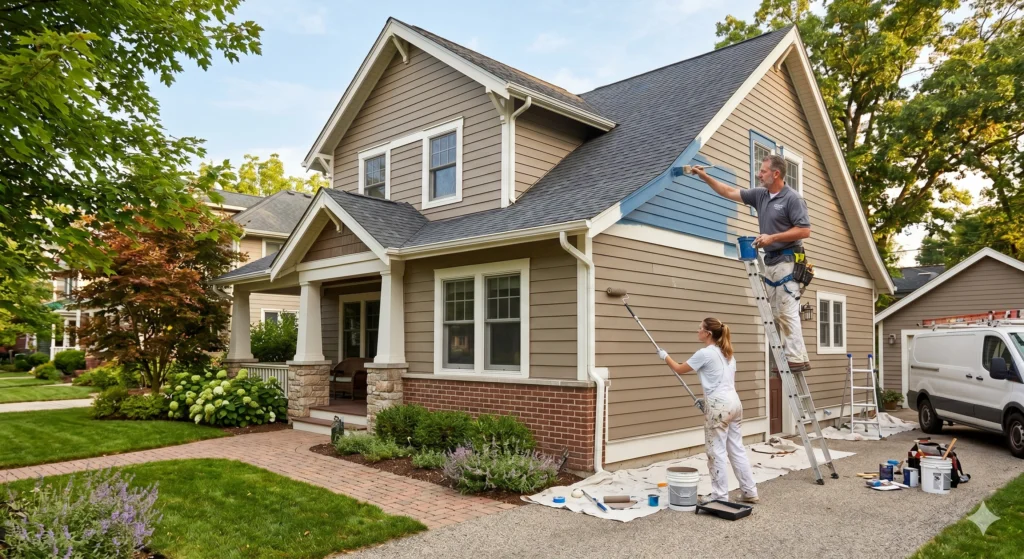
Residential vs commercial painting sounds like a simple comparison until you look at the job site.
A living room repaint and an office building repaint both need paint, prep work, painters, materials, and a clean finish. Still, they are not handled the same way. A house has furniture, pets, trim details, drywall repairs, family schedules, and rooms people care about personally. A commercial property has tenants, customers, business hours, safety standards, high ceilings, larger walls, and coatings that may need to take daily abuse. That is why professional painting services have to account for different timelines, surface conditions, and unique needs from the start.
At Brotherton Painting, we look at each project by how the space is actually used. That matters more than the label. A small retail space can be more complicated than a big residential room. A house exterior with peeling siding can need more care than a clean commercial hallway. Good painting services start with that kind of honest look.
Painting Business Examples Services Residential Commercial
Painting business examples, services residential commercial, is not a phrase anyone would use in normal conversation, but the idea is useful. A painting company that works with both homeowners and businesses has to know how to shift gears. Most painting businesses are built around two core goals: refreshing how a property looks and protecting the surfaces that keep it usable.
Residential painting is typically more personal. The homeowner is thinking about light, comfort, color, trim, smooth finishes, and how the room will feel after the job is complete. Experienced residential painters also have to protect floors, work around furniture, and notice small surface flaws before they affect the final result. Commercial painting is more operational. Businesses care about durability, budget, access, scheduling, safety, and keeping the property presentable without creating unnecessary disruption.
Here is a practical price-range table.
|
Painting project type |
Common price range |
What usually changes the estimate |
|
Residential interior painting |
From $2 to $6 per sq. ft. |
Room size, wall repairs, ceilings, trim, paint quality, number of coats |
|
Residential exterior painting |
From $1.50 to $4.30 per sq. ft. |
Siding condition, number of stories, prep work, access, weather exposure |
|
Commercial interior painting |
From $2 to $6 per sq. ft. |
Open space, business access, labor, coatings, schedule limits |
|
Commercial exterior painting |
From $2 to $6 per sq. ft. |
Building size, height, surface condition, equipment, specialty coatings |
|
Complex commercial exterior work |
From $3 to $8 per sq. ft. |
Lifts, scaffolding, rough surfaces, tight access, advanced coatings |
Interior painting is commonly listed around $2 to $6 per square foot, while commercial painting is also often estimated from $2 to $6 per square foot depending on paint type, building height, surface condition, and scope. Exterior residential ranges vary more by siding, access, and prep work.
Commercial Painting Projects Need More Planning
Commercial painting projects rarely work as “show up, paint, leave.” An office building may need work done one floor at a time. Retail spaces and shopping malls may need painters to work after regular business hours. Restaurants may need fast coordination so the space can reopen without creating problems for staff. Warehouses and facilities may need floor coating, line striping, high-ceiling access, or specialized equipment. Large-scale projects also bring unique challenges for crews, property owners, and project managers because access, safety, and timing all have to stay coordinated.
That is where commercial paint contractors earn their keep. They are not just applying paint. Commercial painting is not only about putting paint on the wall. Access, crews, safety, materials, and timing all have to be managed first, which makes early planning essential on larger or more complex jobs.1
Once the project becomes larger or more complex, commercial painting often costs more than residential work. The reasons are practical: larger project sizes, more time, more labor, more materials, and more equipment. These details can raise the overall cost, especially when scaffolding, lifts, high-powered sprayers, or commercial-grade coatings are required for work that would be unnecessary in most residential projects. Labor costs can also be higher when the job requires specialized skills, safety planning, or equipment that typical residential jobs do not need.
Commercial Painting Services Are Built for Real Wear
Commercial painting has to be tougher because the space is typically tougher. Retail walls get bumped. Restaurant walls get stained and cleaned again and again. Warehouse surfaces may deal with scratches, humidity, chemicals, or abrasion. Add carts, racks, bags, customers, staff, and daily movement, and the paint system has to do more than look fresh for a week. That is why paint used in commercial projects is often more expensive: it has to resist wear from high foot traffic and harsher environmental conditions.
That is where specialty coatings come in. Depending on the project, commercial painters may use waterproofing, epoxy, polyurethane, protective coatings, decorative coatings, or high-performance finishes for concrete, metal, floors, and other demanding surfaces. Epoxy and polyurethane floor coatings are often used on garage floors, warehouse floors, and high-traffic retail floors because they help protect against scratches, humidity, chemicals, and daily wear. A standard interior wall paint can work in a calm office. In a high-use facility, it may be the wrong choice.
A first impression is part of the value. A clean lobby, storefront, shared hallway, or customer-facing space tells people the property is maintained. For businesses, tenants, and facility managers, that is not just cosmetic.
Exterior Painting Looks Different for Homes and Businesses
Exterior painting services for a house often matter because they affect the part of the home everyone sees first. Homeowners notice the siding from the driveway. Tired trim, a faded front door, a worn porch — homeowners notice those details quickly. They also notice when the house no longer has the curb appeal it used to have.
Residential exterior painting can involve siding, brick, stucco, masonry, trim, doors, decks, and other exterior surfaces. The prep can be more involved than people expect. Pressure washing, scraping, sanding, caulking, patching, and primer may all be needed. Peeling paint should not be hidden under a new coat. It has to be fixed before the finish can last.
For homeowners, choosing exterior paint colors is also part of the work. The color has to work with more than personal taste. It should make sense with the roof, landscaping, trim, neighborhood, and the overall style of the house. For more detailed color planning, Brotherton Painting also explains how paintings of interiors can inspire better color choices for real homes, especially when homeowners want a palette that feels intentional rather than random.
Commercial exterior painting has a different purpose. A commercial building needs to look clean and professional from the street, but that is only part of the job. It may also need brand consistency, safety compliance, tenant confidence, long-term durability, weather resistance, and coatings that can handle large surfaces or harsher exposure.
Painting Services for Commercial and Residential Needs
Good painting services account for the fact that a bedroom wall, a kitchen cabinet, exterior trim, and smaller spaces do not need the same treatment.
Residential projects may involve bedrooms, kitchens, bathrooms, living rooms, cabinets, trim, doors, siding, and exterior details. These jobs happen in active homes, not empty spaces. Furniture has to be covered, pets kept safe, children considered, and work schedules planned around real routines. That is why professional interior painting for homes is not only about color. It is also about the details around the paint: protecting floors, repairing walls, choosing the right sheen, and leaving the room clean enough for normal life to start again.
Commercial and residential work share some skills, but the job changes with the setting. Commercial painting services may involve interior repaints, exterior repaints, floor coating, waterproofing, line striping, protective coatings, decorative finishes, and larger projects throughout business facilities. These services help maintain the appearance, function, and value of business facilities, especially when the space receives steady use from employees, tenants, or customers.
A painting company that handles both sides needs range. On one project, the priority may be a flawless finish in a dining room. Next, it may be a durable coating system for a warehouse.
Commercial and Residential Painting Jobs Are Priced Differently
Painting jobs are typically hard to compare from a distance. One house may only need a fresh coat on clean walls. Another may need drywall repairs, trim work, primer, multiple coats, and careful masking around built-in features. One commercial space may be an open office with easy access. Another may have high ceilings, tenants, equipment, rough walls, and strict scheduling limits.
That is why a real estimate matters. A useful estimate should break down labor, materials, prep work, surfaces, coatings, and the scope of the project. If it only gives one vague number, it is hard to know what is actually included.
Commercial jobs may cost more because of scale, labor, equipment, coatings, and scheduling. Residential jobs can also become expensive when there is a lot of detail, damage, or prep work. The cheaper price is not always the better choice if it skips the prep work that helps the finish last.
Decorative Finishes and Specialty Coatings Belong in the Right Place
In the right setting, decorative finishes can do more than add visual appeal. They can give a restaurant more atmosphere, help a retail space feel more connected to the brand, or add depth to a home through cabinets, trim, an accent wall, or a room that needs more character. The same logic applies to smaller exterior details, where choosing the best paint for an exterior door can strengthen curb appeal without repainting the entire home.
Specialty coatings are different. They are usually chosen for performance. A floor coating in a warehouse has a job to do. So does waterproofing. Anti-corrosion coatings, chemical-resistant paints, anti-graffiti coatings, and high-durability coatings are not just design choices. They protect surfaces in places where standard paint may not hold up, including areas exposed to abrasion, corrosion, harsh chemicals, moisture, or frequent cleaning.
The catch is that both decorative finishes and specialty coatings still need prep. Damaged walls, dirty surfaces, loose paint, moisture issues, or poor primer can ruin even good materials.
Commercial Projects Often Need Coordination
Commercial projects can affect employees, customers, tenants, equipment, and daily operations. That is why scheduling is not a side detail.
Some businesses need the job done at night. Some need phased work so one area stays open while another is painted. Some facilities need painters to keep access routes clear, follow safety standards, protect equipment, and work around deliveries.
Residential jobs need planning, too, but the pressure feels different. A homeowner may care about which room gets painted first, where the furniture goes, how long the kitchen will be covered, or whether the house can stay livable during the project.
A good painting contractor asks these questions early. It saves everyone stress later.
What to Know Before Your Next Painting Project
A useful painting estimate starts with the right context: Is the project interior or exterior? Residential or commercial? A project can look simple in photos and still need extra work. Peeling paint, moisture, damaged surfaces, access limitations, additional services, and special coating needs do not always show clearly on camera. That is why a closer look matters before the estimate is finalized.
For your next project, be ready to discuss:
- the areas that need painting
- the current condition of the walls, siding, trim, or coatings
- access issues, high ceilings, or open space areas
- whether the job needs specialty coatings or decorative finishes
- business schedule limits or tenant access needs
- whether older painted surfaces may be involved
One important note: paid contractors who disturb paint in housing and child-occupied facilities built before 1978 generally must be certified in lead-safe work practices.2 The more honest the scope is, the better the estimate will be.
What is the main difference between residential and commercial painting?
Residential painting usually focuses on detail, comfort, personal taste, and finish quality. Commercial painting focuses more on durability, scheduling, safety, access, and coatings that can handle heavier use.
Why does commercial painting usually cost more?
Commercial painting projects often involve larger spaces, more labor, more materials, specialized equipment, safety planning, and coatings built for high-traffic or demanding environments.
What are common commercial painting services?
Commercial painting services can include interior repaints, exterior repaints, waterproofing, floor coating, line striping, protective coatings, decorative coatings, and work for offices, retail spaces, warehouses, restaurants, and facilities.
What are common residential painting services?
Residential painting services often include interior walls, ceilings, trim, doors, cabinets, exterior siding, masonry, decks, and detailed surface preparation.
Do commercial painters need special equipment?
Often, yes. Commercial painters may use lifts, scaffolding, high-powered sprayers, safety gear, and other specialized equipment for large buildings, high ceilings, rough surfaces, or hard-to-reach areas.
Are specialty coatings only used on commercial projects?
No, but they are more common in commercial projects. Floor coating, waterproofing, protective coatings, and industrial coatings are usually chosen when surfaces face heavy traffic, moisture, chemicals, or abrasion.
How should I compare painting estimates?
Compare prep work, materials, labor, number of coats, surfaces included, warranty details, schedule, and cleanup. A low price may not include the same level of preparation or quality.
When should I request a free quote?
Request a free quote when you know the general scope of the project, the property type, the areas that need painting, the surface condition, and any access or scheduling concerns.