
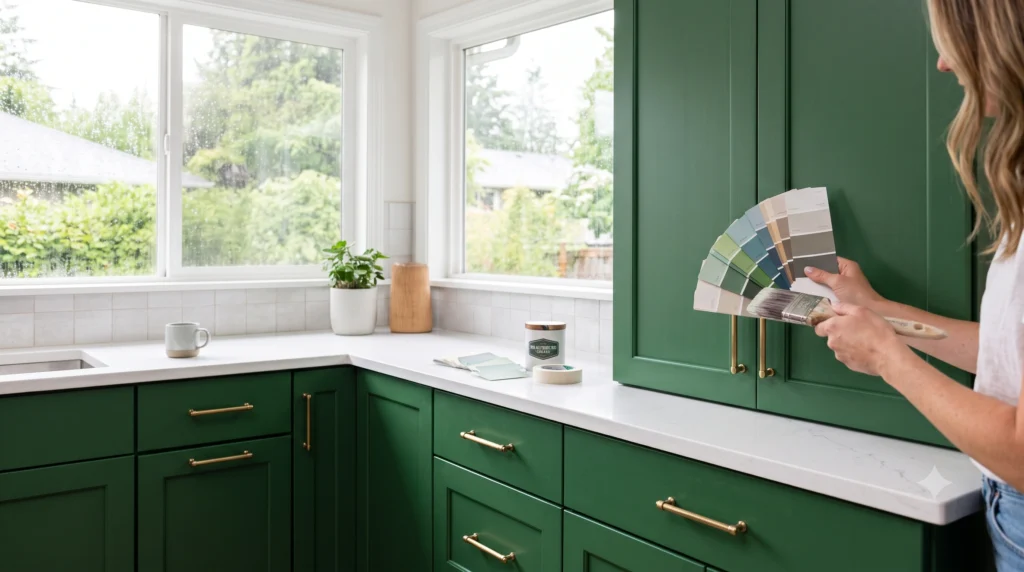
For Seattle and Puget Sound homeowners, cabinet painting can be a smart middle ground when the kitchen looks tired, but the layout still works. Not every home needs a full cabinet replacement just to get a cleaner, brighter, more current kitchen. Sometimes the cabinet boxes are solid, the storage works, and the real problem is the color, worn finish, or dated doors.
At Brotherton Painting, we see this a lot in Seattle homes. A cleaner, more current kitchen sounds good, especially when the rest of the space already works for daily life. Weeks of dust, demolition, and endless decisions usually do not. If the existing cabinets are in good condition, kitchen cabinet painting can give the room a new look without the cost and disruption of replacing everything.
Still, paint only works when the cabinets are worth saving. Before a Seattle cabinet painting project makes sense, the cabinet boxes, doors, drawer fronts, hinges, and exposed edges need an honest look.
A cabinet painting project is usually worth considering when:
- the cabinet boxes are solid and square;
- the layout still works for daily use;
- the doors and drawer fronts are not warped or falling apart;
- the main issue is color, worn finish, or dated style;
- moisture damage has already been ruled out or repaired.
Warped, water-damaged, loose, or poorly built cabinetry will not become strong because it has a fresh finish. You can paint cabinets all day, but the underlying condition has to make sense first.
Cabinet Painting Cost in Seattle: How Kitchen Size Changes the Decision
The cost of cabinet painting depends on several things: kitchen size, cabinet count, surface condition, materials, and prep work. For a small kitchen with cabinets in great shape, painting can often save money because the cabinet boxes stay in place, and the work focuses on prep, primer, and finish. In Seattle homes where the layout already works, painting cabinets is often a more practical update than paying for a full replacement project.
A national cost guide lists the basic cost to paint kitchen cabinets at about $5.40 to $10.79 per square foot as of May 2026. Other industry ranges often put painting kitchen cabinets somewhere around $1,500 to $5,000, while professional cabinet painting projects for a medium-sized kitchen can reach $6,000 to $10,000 when there are many cabinet doors, drawer fronts, repairs, and detailed finishing needs.
Kitchen update option | Common cost range | What changes the price |
Paint kitchen cabinets | $1,500 to $5,000 | Kitchen size, prep, paint, labor |
Professional cabinet painting, medium-sized kitchen | $6,000 to $10,000 | Cabinet count, condition, finish quality |
Cabinet painting per square foot | $5.40 to $10.79 | Surface area, materials, labor |
Cabinet refacing | $4,000 to $9,500+ | New doors, drawer fronts, veneers |
Full cabinet replacement | Can exceed $77,000 | Materials, layout, installing, custom work |
The total cost is not only the paint on the surface. It also includes prep work, labor, primer, supplies, masking, repairs, coats, hardware handling, and quality assurance checks before the job is considered finished. Even with all those steps included, cabinet painting is often still cheaper than refacing or full replacement.
Seattle Kitchen Cabinets Can Look New Without a Full Remodel
A full remodel has its place. If the layout is frustrating, storage is poor, or the cabinet boxes are falling apart, paint will not solve enough. But in many Seattle-area kitchens, the layout still works, and the cabinets simply look dated. When the boxes are strong and the kitchen already functions well, replacement is not always the better answer.
Cabinet painting keeps the parts that still work. The boxes stay. The layout stays. For homeowners in Seattle, Bellevue, Tacoma, and nearby Puget Sound communities, that can be the main advantage: the kitchen gets an updated look without throwing away useful cabinetry just because the surface needs a new finish.
What stays | What changes | Why it matters |
Cabinet boxes | Color and finish | The kitchen can feel newer without changing the footprint |
Existing layout | Visual style | Useful storage does not get removed unnecessarily |
Cabinet structure | Surface appearance | The project focuses on appearance and finish quality |
Kitchen footprint | Hardware, if updated | Small details can make the finished kitchen feel more current |
That is one of the main reasons homeowners consider it. A new color can help transform the room and achieve an updated look without changing the kitchen footprint. White, warm gray, deep green, navy, soft taupe, or a two-tone style can make old kitchen cabinets feel current again.
This is also where kitchen cabinet painting feels less disruptive. You are not waiting on new cabinets, tearing out storage, or living through a full replacement. There is still prep, masking, drying, and curing, but the process is usually lighter than demolition and installing new cabinetry.
Cabinet Doors and Drawer Fronts Can Carry the Whole Look
Most people notice the cabinet doors first. Then they notice the drawer fronts, knobs, and visible panels. The boxes matter structurally, but visually, the doors do most of the work.
That is why cabinet painting can be so effective. If the doors are in good condition, a professional finish can make the whole kitchen feel different. Add updated knobs or pulls, and the change can feel bigger than expected.
Cabinet refacing goes further. With refacing, the old doors and drawer fronts are usually replaced, while the existing cabinet boxes stay in place. It is a cost-effective way to change the style more dramatically than paint alone. Still, refacing costs more than painting because it uses more materials and more labor.
Option | Best when | Main limitation |
Cabinet painting | The doors are in good condition and the main issue is color or finish | It does not change the door profile |
Cabinet refacing | The boxes are solid, but the doors look dated | It costs more than painting |
Cabinet replacement | The layout, storage, or cabinet structure is failing | It usually brings the most disruption and cost |
So the choice is practical. If the style of the doors is fine, painting may be enough. If the door profile itself feels dated, cabinet refacing may make more sense.
Cabinet Painting Services Can Be Less Disruptive for Seattle Homes
A full replacement can take weeks. There may be demolition, measuring, ordering, delivery, installing, electrical or plumbing adjustments, and countertop questions. It can add up quickly.
Cabinet painting projects are usually more contained. A cabinet painting project can often be completed in about 3 to 5 active workdays. But once the painters leave, the finish may still be curing. Some coatings can take 5 to 7 days to reach full cure, so the cabinets should not be treated roughly right away.
Good cabinet painting services are planned, not improvised. For Seattle and Puget Sound homes, that planning matters because kitchens are used daily, surfaces collect grease and hand oils, and moisture can make poor prep show faster.
A well-planned cabinet painting project usually includes:
- removing or carefully handling cabinet doors and drawer fronts;
- protecting the kitchen, floors, counters, and nearby surfaces;
- cleaning grease, dust, hand oils, and old residue;
- preparing edges, grooves, and corners;
- allowing enough drying and curing time before normal use.
Compared with a full remodel, the work is quieter.1 That does not make it less detailed.
Prep Work Makes or Breaks a Professional Cabinet Finish
This is where many DIY projects go wrong, especially when the goal is a smooth cabinet finish that can hold up to daily cooking, cleaning, and repeated handling. Good cabinet painting is not only about choosing a color. The prep has to be patient.
A basic prep sequence usually looks like this:
- Clean off grease, dust, and hand oils.
- Sand or scuff the surface so the primer can bond.
- Repair small damage before coating.
- Apply the right primer for the cabinet material.
- Build the finish with multiple thin coats.
One thick coat does not make the job stronger. It can sag, dry unevenly, and chip later.
Primer also does real work. Most painters know a cabinet-grade primer gives the finish a better chance to last. It helps block bleed-through and improves adhesion, especially on cabinet surfaces that see daily use. Without it, paint failure often starts around handles, drawers, sink zones, and cabinet edges.
A brush can handle some detail areas, but a factory-like finish takes more than brushing paint onto the surface. It needs clean prep, steady control, and careful coating. Doors, drawer fronts, grooves, and corners all need attention if the final result is going to hold up.
That is why learning what cabinet painting involves helps before you decide between diy and hiring painters. The work can look simple from the outside. In practice, the details matter.
Painting Can Be Better for Existing Cabinets in Great Shape
If the existing cabinets are solid wood or well-built boxes in good condition, painting may be the more sensible choice. This is especially true in Seattle homes where the kitchen footprint still works and the goal is a cleaner, more updated look rather than a full layout change. Replacing them is not always necessary.
Older cabinets can still have real value. Some are built better than newer budget cabinetry. If the doors close properly, the boxes are square, the storage works, and the wood is not damaged, paint can refresh the kitchen while keeping the useful structure intact.
There is also less waste involved. Painting keeps functional cabinet materials out of landfills and avoids the manufacturing and shipping connected with new cabinets. For homeowners who want a cleaner, updated kitchen without overbuilding the project, that is a practical benefit.
But there is no point pretending paint can fix everything. If cabinets are swollen, warped, moldy, falling apart, or poorly installed, the problem remains under the surface. In Seattle homes, moisture is not something to ignore, especially around sinks, dishwashers, and poorly ventilated areas. Any moisture problems that should be handled first need to be fixed before painting starts.2
Watch for warning signs such as:
- swelling near the sink or dishwasher;
- soft or crumbling cabinet edges;
- peeling finish caused by moisture;
- musty odors inside cabinet boxes;
- loose doors that no longer sit correctly.
Paint should finish the cabinet surfaces. It should not be used to cover damage that still needs repair.
Cabinet Refacing or Replacement May Still Be Better Sometimes
Cabinet painting is not always the right answer.
If the kitchen feels wrong because of the layout, storage, cabinet height, or appliance placement, painting is not enough. The cabinet boxes remain where they are. The room does not gain space. Storage stays mostly the same unless you upgrade the inside with organizers or hardware.
Cabinet refacing may be the better middle ground when the boxes are strong but the doors are dated. It keeps the cabinet boxes in place while replacing the visible parts, usually doors and drawer fronts. Veneer can also be added so the boxes match the new fronts. It costs more than painting, but it can create a bigger style update.
Full replacement is the right move when the cabinets have deeper problems. Damage, poor construction, a bad layout, or cabinet boxes that are not worth saving all point toward replacement. New cabinets can change the kitchen more completely, but they also come with a much higher price, longer timeline, more materials, and more disruption.
A good decision does not come from one fixed rule. It comes from looking at the cabinets honestly and deciding what the kitchen actually needs: a better finish, new doors, improved storage, or a full replacement. For Seattle-area homeowners, that honest assessment matters more than chasing the biggest project.
FAQ
Is cabinet painting cheaper than replacing cabinets?
Yes, cabinet painting is usually cheaper than full cabinet replacement. The cost depends on kitchen size, cabinet condition, materials, prep work, and the level of finish.
How much does cabinet painting cost?
Cabinet painting cost can range from about $1,500 to $5,000 for many kitchens. Professional cabinet painting projects for a medium sized kitchen may cost $6,000 to $10,000 depending on cabinet count and condition.
Can I paint kitchen cabinets myself?
You can, but diy cabinet painting takes patience. Thorough cleaning, sanding, primer, masking tape, good supplies, and thin coats all matter. Skipping prep often leads to peeling or chipping.
When is cabinet replacement better?
Cabinet replacement is better when the boxes are damaged, warped, poorly built, or the kitchen layout no longer works. Painting cannot fix bad storage or failing cabinetry.
What is the difference between cabinet painting and cabinet refacing?
Cabinet painting updates the existing cabinet surfaces with paint. Cabinet refacing usually keeps the boxes but replaces cabinet doors and drawer fronts, often with new veneer on visible areas.
How long does kitchen cabinet painting take?
Cabinet painting typically takes about 3 to 5 days for active work, depending on kitchen size and prep. The finish may need several more days to fully cure.
Will painted cabinets chip?
They can chip if prep is poor, the wrong materials are used, or the cabinets are handled roughly before curing. A professional finish with proper sanding, primer, and coats is more durable.
Does cabinet painting work on every material?
Not always. Wood, laminate, vinyl, and other materials may need different prep, primer, or products. Some damaged, glossy, or slick surfaces may not be good candidates for paint.
Is cabinet painting a good option for Seattle homes?
Yes, if the cabinet boxes are solid, the layout works, and there are no unresolved moisture issues. In many Seattle homes, cabinet painting can transform the kitchen and achieve an updated look without the cost, waste, and disruption of full cabinet replacement.