
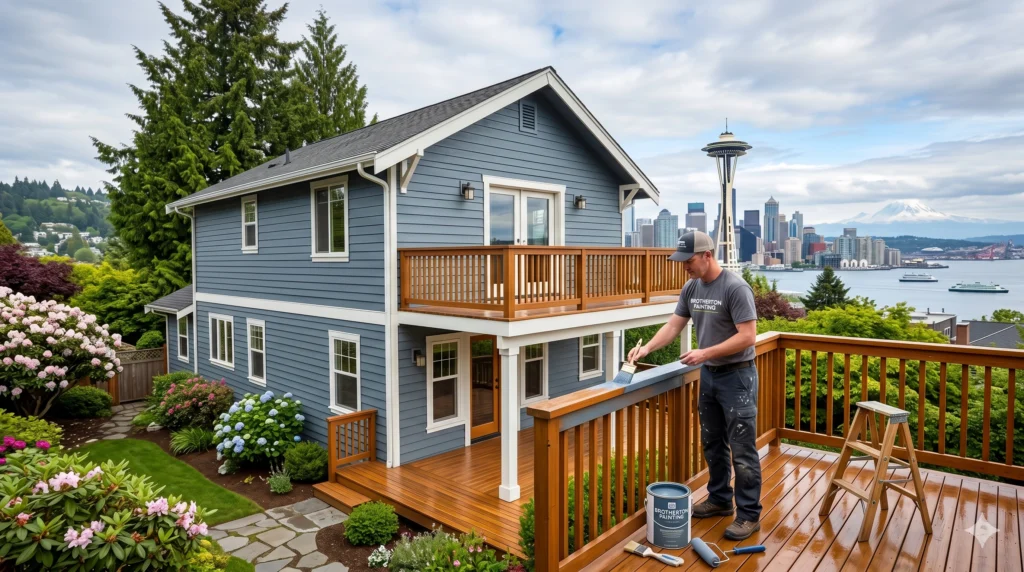
How often should you paint a house in Seattle? Most homeowners want a clean number. Five years. Seven years. Ten years. The real answer is a little less tidy.
At Brotherton Painting, we usually look at the house first, then the calendar. Seattle homes do not age the same way. One home may sit under tall trees with shaded siding that stays damp after rain. Another may get more direct sunlight and show fading before mildew. Another house may have older wood siding, caulk lines starting to split, or paint that seemed fine during summer but failed after a long, wet winter.
On homes exposed to the Pacific Northwest climate, exterior paint often lasts somewhere around 5 to 10 years.1 Wood siding and other exterior wood surfaces tend to need maintenance sooner, often within 5 to 7 years. Brick, vinyl, and masonry can last longer, though coating type, exposure, surface condition, and proper maintenance all matter. But age is only a starting point. The surface is usually the better warning sign.
Best Exterior Paint for Seattle Weather: Latex Paint, Acrylic Paint, and Weather Resistance
Exterior paint in Seattle has to be practical. The right exterior paint is not always the most expensive product, but the one that can handle rain, humidity, shade, UV exposure, and temperature fluctuations.
That is why acrylic latex paint is often used. It offers flexibility, water resistance, and enough breathability for many exterior surfaces. In wet climates, trapped moisture can become a real problem, leading to blistering, peeling, and paint failure before the coating should be done.
Not all paints are ready for that kind of weather. Some exterior house paint products look good at first, but struggle with constant moisture, mildew growth, or poor paint adhesion. A high-quality exterior paint should help with moisture resistance, mildew resistance, and general weather resistance while creating a more fade-resistant finish.
Paint Brands Like Sherwin-Williams: What Actually Matters
Paint brands matter. But they do not matter more than prep. Sherwin-Williams, Benjamin Moore, Miller Paint, and Rodda Paint all have exterior products commonly used on homes in the Pacific Northwest climate. The better question is not just which brand to choose. It is whether the right paint matches the surface, exposure, and current condition of the home.
Exterior House Paint in Rainy Climates: When It Usually Starts to Wear Out
Seattle’s weather can wear down exterior paint faster than people realize.2 Frequent rain, cool, damp mornings, shaded walls, and humid conditions all matter. Add UV exposure, rough weather, and caulk that has started to fail, and the timeline can shorten quickly.
Exterior surface | Common repaint range | What usually causes problems |
Wood siding | 5 to 7 years | Moisture retention, shade, cracked caulk |
Stucco surfaces | 5 to 6 years | Small cracks, porous surfaces, trapped moisture |
Metal siding | 5 to 7 years | Rust, fading, poor adhesion |
Vinyl siding | 10+ years | Chalking, fading, UV exposure |
Brick or masonry | 15 to 20 years | Wrong coating, moisture damage |
These ranges are useful, but they are not a promise. A careful paint job with proper surface preparation and high-quality paint can last longer, especially when painted surfaces are cleaned, dried, and repaired before work begins. A rushed job over damp siding may fail early, even if the paint itself is good.
Exterior House Paint Warning Signs You Should Not Ignore
A house usually gives warnings before the exterior paint fully fails. Peeling is the easiest warning sign to understand. Lifting paint, cracks, and flakes usually mean the coating is failing or that the paint adheres poorly to the surface. Chalking is quieter, but it matters too. If your palm comes away dusty after rubbing the siding, the paint film is breaking down.
Mold and mildew are common in shaded Seattle areas because those surfaces dry more slowly. In humid environments, poor airflow and limited sun exposure can also encourage mold growth. Sometimes cleaning is enough. When mildew returns again and again, the surface may need more attention than a wash.
Look closely at the caulk around trim, windows, and doors. It cracks with age. Once gaps open, water can move behind the paint and into the wood. That is how swelling, softness, and rot can start.
Fading may not feel like a big problem, but it still matters. UV rays break paint down slowly, even in the Pacific Northwest. One sunny side of the home may fade long before the entire house looks worn.
Oil-Based Paints and the Best Exterior House Paint for Seattle Homes
Latex paint works well for many residential painting projects because it is easier to apply, dries faster than many older products, and performs well on a wide range of exterior walls. Unlike interior walls, exterior surfaces have to deal with rain, UV exposure, dirt, and seasonal movement. In Seattle, acrylic latex paint is often the better answer because it is more flexible and better suited to moisture.
Oil-based paint can still be useful on some trim or specialty surfaces. That does not make it the best choice for most full exterior jobs. It can dry slowly, be harder to work with, and become frustrating in humid environments where proper ventilation and drying time are limited.
Elastomeric paint is another option. It forms a flexible protective coating and can work well on concrete surfaces, stucco surfaces, and other porous materials. Some products also come with a self-priming formula, but that does not mean they can skip cleaning, repair, or surface evaluation. Elastomeric coatings can expand and contract with the surface, which is useful in extreme weather conditions. But they are not automatically the best exterior house paint for every home. The surface has to call for it.
Weather-Resistant Paints with Mildew Resistance for Seattle’s Wet Climate
Weather-resistant paint has to be ready for more than a rainy stretch. It needs to handle moisture, harsh weather, UV exposure, temperature movement, and everyday contact with the elements.
Mildew resistance is especially important in Seattle. Mildew-resistant paints use additives that help slow fungal growth across the paint film. Anti-mold products can also be useful where damp conditions make mold and algae return often. Still, no paint product can do all the work on its own. The surface needs to be clean, properly prepped, and able to dry.
Shaded walls, trim, and siding near plants are exactly where moisture-resistant paint earns its place. Those areas dry slowly, especially after rain, and wet conditions can keep painted surfaces vulnerable longer than homeowners expect. If moisture stays trapped too long, the coating can peel, crack, or lose adhesion. Add poor drainage or landscaping pressed against the house, and even strong exterior paint has a harder time lasting.
This is why exterior painting work planned around local weather matters so much in Seattle. Timing is not a small detail. Paint has to go on dry exterior surfaces, in the right weather conditions, with enough time to cure.
Surface Prep, Thin Layers, and Weather-Resistant Paints
Homeowners often care most about the paint itself. The color is visible. The brand feels like the big decision. But the surface underneath carries a lot of the result. Before exterior painting, a residential painting crew may need to power wash the house, remove dirt, clean mildew, scrape loose paint, sand rough areas, seal cracks, and prime bare or damaged sections. Without that, the new coating has a weaker surface to grip.
Bare wood needs primer. Weathered siding may need more careful preparation. Porous surfaces can absorb paint unevenly if they are not treated first. That is why poor prep can ruin even a good paint product.
And the paint should go on in controlled layers. Thick coats can dry unevenly and create problems later. Thin layers usually cure more evenly and build a more durable finish with better long-lasting protection.
Best Exterior House Colors for a Seattle Painting Project
A good exterior color should fit the house first. Still, the Pacific Northwest gives certain colors an advantage. Sage, moss, forest green, and other muted greens feel natural because they connect with the evergreen landscape. Soft grays and cool whites work well under Seattle’s cloudy light. Deep blues can add a stronger note without feeling too loud.
Taupe, beige, muted cream, and other earth-toned neutrals also fit this region well. They work nicely with darker trim, wood accents, and stone. Lighter shades may show fading less than dark colors, which can help on walls with more direct sunlight.
Accent colors are useful when the homeowner wants character without a full exterior color change. A front door in deep red, mustard yellow, navy, or another rich shade can add that detail, especially on doors, porch areas, and other high-traffic areas people notice first.
The same idea applies to refreshing a garage door with paint. A garage door takes up a lot of visual space. Updating it can improve curb appeal without turning the whole painting project into a full repaint.
When Repainting Can Wait, and When It Should Not
Not every faded exterior needs a full repaint right away. Sometimes the better move is simple: wash the surface, handle a small repair, or touch up a worn area where the painted surfaces are still sound.
The warning signs are different. Peeling paint, cracked caulk, bare wood, and mildew that keeps coming back all point to a surface that needs attention sooner. Exterior paint is part of the home’s moisture protection, not just the color people see from the street. The right paint can support long-lasting protection when the surface is prepared correctly.
Professional painters can help separate normal wear from a real problem. The home may need a full repaint, partial repair work, or maintenance that carries it through another season. Repainting too early can waste money, while waiting too long can make the next job harder and more expensive. Homeowners who want to plan the budget more clearly can review what affects house painting cost in Seattle before scheduling the work.
FAQ
How often should you paint a house in Seattle?
Most Seattle homes need exterior painting every 5 to 10 years. Wood siding often needs repainting closer to 5 to 7 years, especially in shaded or damp areas where the Pacific Northwest climate keeps moisture on the surface longer.
What exterior paint works best for Seattle weather?
The best exterior paint for Seattle weather is usually a premium acrylic latex paint with strong moisture resistance, mildew resistance, and weather resistance.
Is latex paint good for Seattle homes?
Yes. Latex paint can work well, especially acrylic latex paint. It is flexible, water-resistant, and practical for many exterior projects in wet climates.
Are oil-based paints a good choice for exterior painting?
Oil-based paints can work for some specialty surfaces, but they are less common for full exterior painting today. Acrylic paint is often a better fit for humid climates.
What causes paint failure in Seattle?
Moisture, poor prep, damp surfaces, failing caulk, mildew, UV rays, and bad weather conditions can all lead to early paint failure.
Do weather resistant paints stop mold and mildew?
They can help reduce mold and mildew on the paint film, especially when they include mildewcides. The home still needs cleaning, airflow, and moisture control.
Can elastomeric paint be used on every exterior house?
No. Elastomeric paint can work well on stucco, concrete surfaces, and other porous materials, but it is not right for every siding type.
When is the best time to paint a house in Seattle?
The best time is usually during the drier months, often late spring through early fall. Paint needs dry surfaces, suitable temperatures, and enough time to cure.